

DSU students win $40,000 in seed funding with AI chip design platform
A team of Delaware State University students is putting the foundation they built at DSU to work, turning their knowledge, skills and creativity into a winning AI chip design platform that earned $40,000 in seed funding at the Venture Innovation Summit 2.0.
Held in April on DSU’s Dover campus, the summit brought together students, entrepreneurs and industry professionals to share ideas and pitch solutions to real-world challenges. Through a series of presentations, teams competed for funding to help move their projects forward.
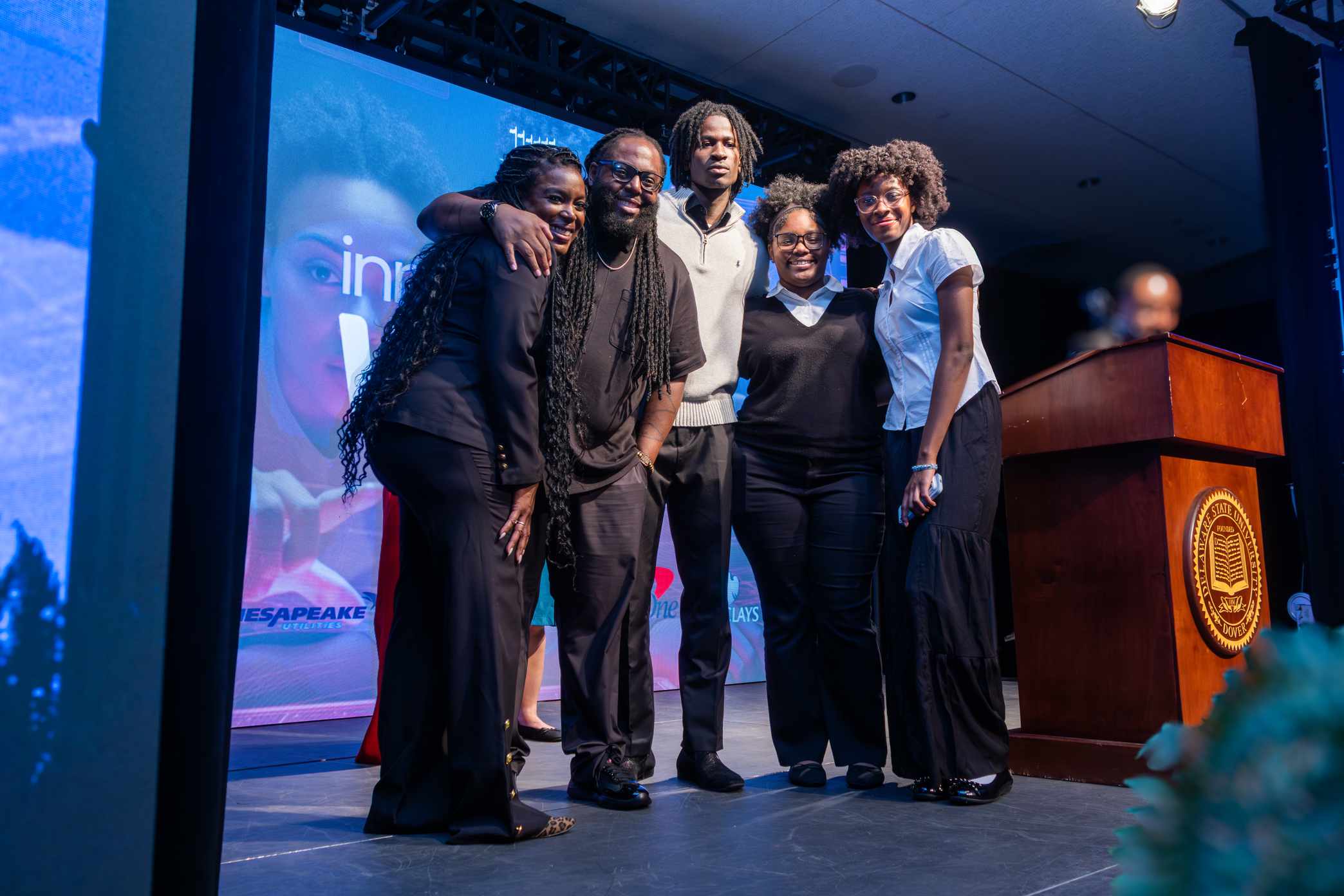
Among the top teams was Team Blur, a group of four Delaware State undergraduates and one doctoral student who developed PrizeChips, an artificial intelligence-driven platform designed to make semiconductor design faster, more efficient and more accessible.
The team includes Malcolm Coley, a doctoral student in artificial intelligence, along with Kihangu Waweru, Saniyah Bullock and Isata George, all junior computer science majors.
For Bullock, the win represents more than recognition. It reflects the values and lessons shaped through her time at Delaware State.
“Winning Innovation Venture is a meaningful step toward our goal of bridging the gap for engineers around the world,” Bullock said. “Delaware State taught me that higher education should not be limited by cost, and PrizeChips carries that same idea into chip design, an industry that traditionally locks out those without expensive resources. My courses at DSU built my technical skills and my sense of responsibility to the communities I come from. ‘Enter to learn, go forth to serve’ is not just painted on the walls. It is in everything we produce.”
Waweru said the team’s academic experience played a direct role in preparing them for the competition and shaping the project itself.
“Our victory at Innovation Venture 2.0 greatly supports our goal of making semiconductor design more accessible,” Waweru said. “This achievement is largely due to my time at Delaware State University. Classes like Data Structures and Algorithms and Software Engineering gave us the technical foundation we needed to build it. Overall, this win shifted our focus from ‘what if’ to providing local, AI-powered design space exploration for HBCUs and minority startups. We are not just building a platform. We are creating a gateway into a whole industry.”
George said the team’s ability to move from an idea to a competitive platform was rooted in both technical and collaborative skills developed at DSU.
“This win proved that PrizeChips is a major and necessary step toward making the semiconductor field more accessible for HBCU students,” George said. “Courses at DSU taught us the hard skills, but just as importantly, they taught us soft skills like collaboration and adaptability. Without that, we likely would not have been able to push forward and bring this idea to the Innovation Venture stage.”
Coley said the project reflects a broader mission shaped by the university’s academic environment and culture.
“Securing the Innovation Venture is a major step toward making the semiconductor field accessible to HBCU students worldwide,” Coley said. “PrizeChips is built on the lessons we learned at Delaware State, that high-level design should be defined by skill, not budget. By combining technical expertise with DSU’s spirit of collaboration within the College of Agriculture, Science and Technology, we have moved from the classroom to the cutting edge. We do not just build chips. We serve our community by breaking down the walls of an exclusive industry. This win proved that.”
Developed under the guidance of Professor Tariq Hook, PrizeChips uses artificial intelligence and open-source tools to reduce a process that can take weeks of manual work into a significantly faster workflow, lowering barriers to entry in the semiconductor field.
For Team Blur, the experience marks a shift from learning in the classroom to building something with real-world impact, using their education at Delaware State University as the foundation.