

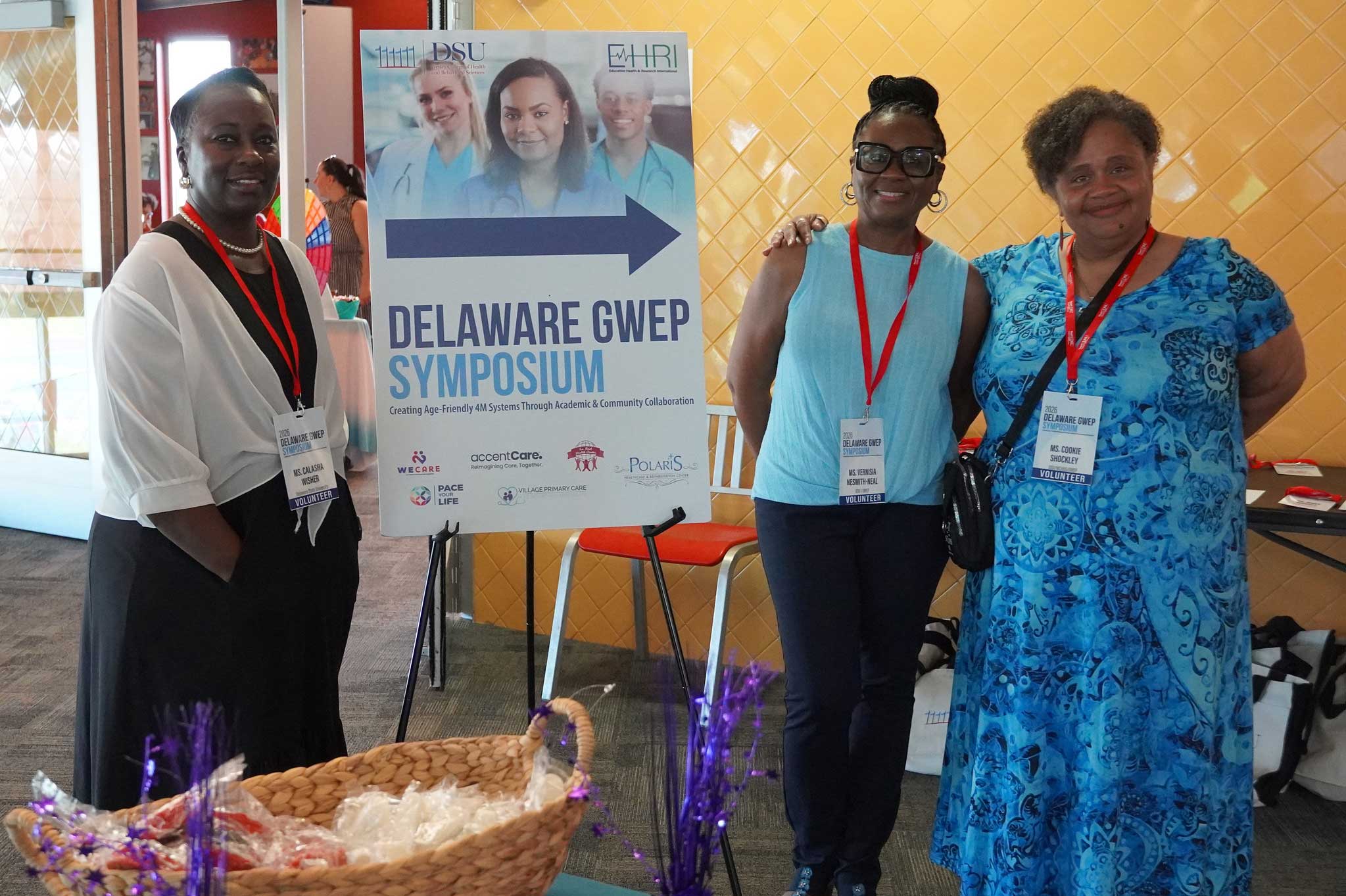
DSU Hosts Second Geriatric Workforce Enhancement Symposium
As Delaware’s older adult population continues to grow, healthcare providers, educators and community leaders gathered at Delaware State University on June 5 to explore new ways to strengthen care, expand workforce training and improve health outcomes for aging residents.
Click here to view photos from the event
Hosted by Delaware State University and Education Health and Research International (EHRI), the second Geriatric Workforce Enhancement Symposium brought together healthcare professionals, students, faculty and community partners for a day of presentations, discussions and resource sharing focused on the challenges and opportunities facing Delaware’s aging population.
The event highlighted the work of Delaware’s Geriatric Workforce Enhancement Program (GWEP), a federally funded initiative designed to strengthen the state’s healthcare workforce through education, collaboration and evidence-based approaches to aging care.
Opening remarks were delivered by Dr. Gwendolyn Scott-Jones, Dean of the School of Graduate, Adult and Extended Studies and the Wesley College of Health and Behavioral Sciences; Rabbi Halberstam, Chief Strategy Officer of EHRI; and Dr. Karen Panunto, Principal Investigator for Delaware’s GWEP Initiative. The program was moderated by Dr. Dawn Mosley, Head of DSU Marketing and Communications.
Throughout the symposium, presenters examined key issues affecting older adults, including dementia care, medication management, advanced care planning and interdisciplinary approaches to healthcare delivery.
Dr. Lois M. Chappell discussed strategies for reducing medication-related risks through safe deprescribing practices, while Christie Whitlock, MSN, APRN, FNP-C, addressed the importance of advanced care planning in long-term care settings. Clinton Middleton, MSN, APRN, FNP-D, shared insights on the Guiding an Improved Dementia Experience (GUIDE) model and approaches to supporting individuals living with dementia and their families.
Additional sessions explored comprehensive primary care across the adult lifespan and the role of collaborative, interdisciplinary care in improving outcomes for older adults.
Nicole Hunter, a Nurse Practitioner with Optum, said the symposium focused on some of the most pressing issues facing Delaware’s aging population.
“I thought it was a great conference,” Hunter said. “It focused on key components of improved care delivery for our geriatric population, as well as the dementia population. Deprescribing and advanced care planning are integral to producing improved health outcomes for our populations in Delaware.”
For many attendees, the symposium underscored the growing importance of gerontology education as Delaware’s population ages.
“It’s going to make practitioners look at gerontology differently,” said Dr. Khadjina-iisha Shockley, Administrative Assistant and Budget Analyst in DSU’s Wesley College of Health and Behavioral Sciences. “The people who were here today learned a lot of information, and I believe they will pay that information forward.”
The symposium also showcased the continued growth of Delaware’s GWEP initiative, which is completing its second year and expanding its reach through partnerships with healthcare providers, educational institutions and community organizations throughout the state.
Rachel Fields, a GWEP Content Expert and Nurse Practitioner, said the program continues to build momentum while preparing future healthcare professionals to meet the needs of Delaware’s aging communities.
“This is our second symposium, and we’re getting more engagement every year,” Fields said. “We are successfully teaching nursing students, social work students, occupational therapy students, staff at clinical sites and our community partners.”
Representatives from Milford Wellness Village, Beebe Healthcare, WeCare, Polaris, Tailored Care LLC, the Centers for Medicare & Medicaid Services, AccentCare, La Red Health Center and DSU’s Nursing Graduate Program participated through exhibits and resource tables that connected attendees with services, workforce opportunities and community resources.
A key partner in Delaware’s GWEP initiative, Milford Wellness Village has become a model for integrated care by bringing healthcare, education, wellness and community services together in one location. The collaborative approach helps improve access to care while strengthening connections among providers, organizations and residents.
Supported through a five-year federal grant, Delaware’s GWEP initiative is part of a national effort to strengthen the geriatric workforce and improve care for older adults. Through partnerships across the healthcare, education and community sectors, the program continues to expand training opportunities and prepare professionals to meet the evolving needs of Delaware’s aging population.