

From Patient to Researcher DSU Student Returns to Nemours
For Delaware State University junior Emmanuel Shomide, spending the summer conducting research at Nemours Children’s Health carried a personal meaning.
Years before joining researchers in the lab, Shomide had been a patient at Nemours. The experience left him with an appreciation for the organization and its work with children. This summer, the biological sciences major and chemistry minor returned in a much different role, contributing to research while gaining experience that brought him closer to his goal of becoming a physician.
“Having been a patient at Nemours myself, I have always admired the impact the organization has on children’s lives and hoped to contribute to that mission through research,” Shomide said.
Shomide, a New Castle, Delaware, native, spent the summer conducting research in the Pediatric Translational Neuroimaging Lab at Nemours Children’s Health in Wilmington. The lab focuses on developing advanced imaging methods that can help researchers better detect and understand disease.
There, Shomide worked alongside Dr. Xuyi Yue who leads the lab, as well as researchers Dr. Hanieh Karimi, and Dr. Xuan Fu. Their work includes developing specialized tracers used with positron emission tomography to study disease inside the body.
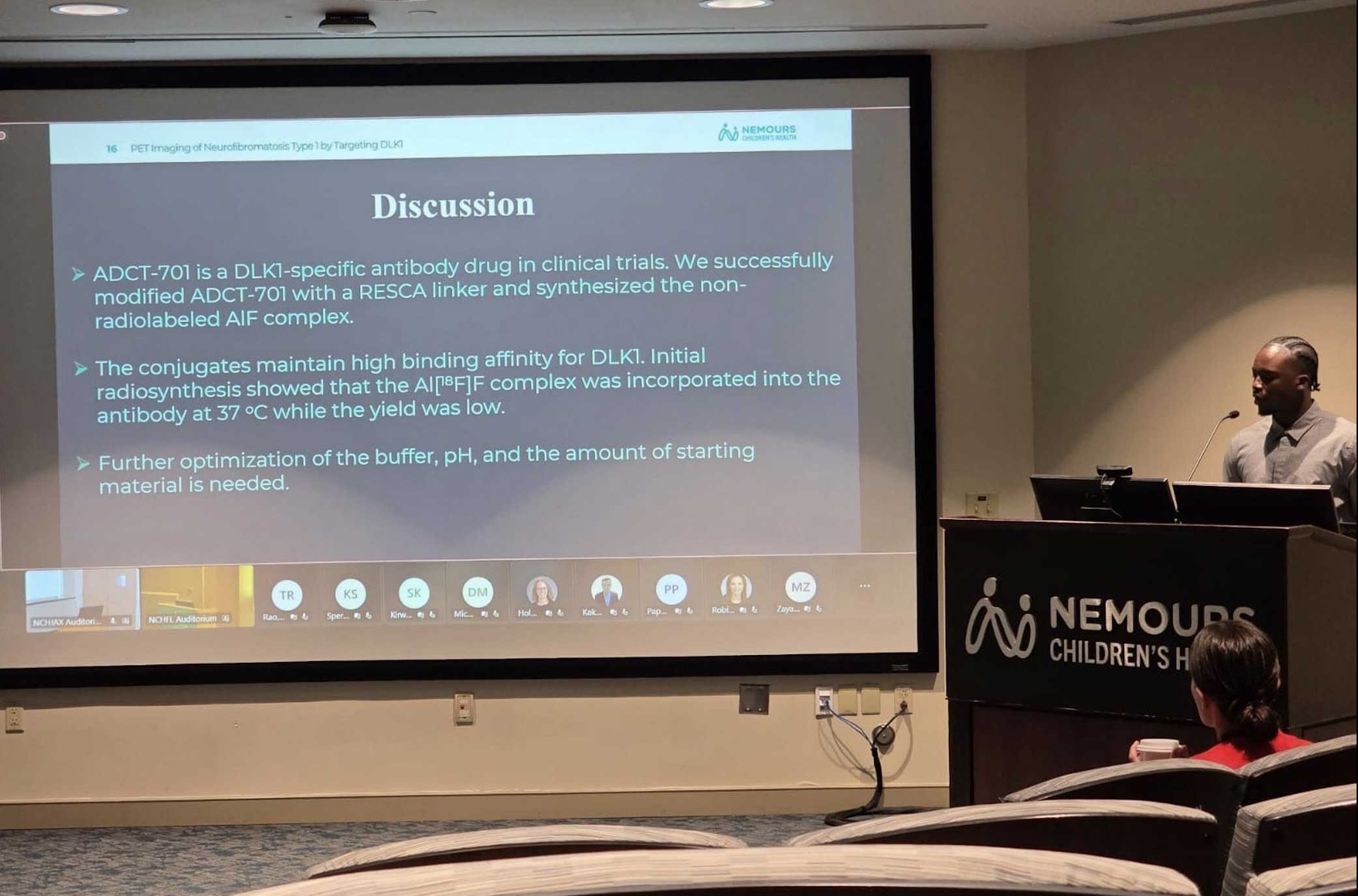
Shomide’s summer project focused on Neurofibromatosis Type 1, a genetic disorder that can cause tumors to develop along nerves. The research team is working to develop an imaging agent that targets a protein known as DLK1, with the goal of creating a noninvasive way to help detect when tumors associated with NF1 become cancerous.
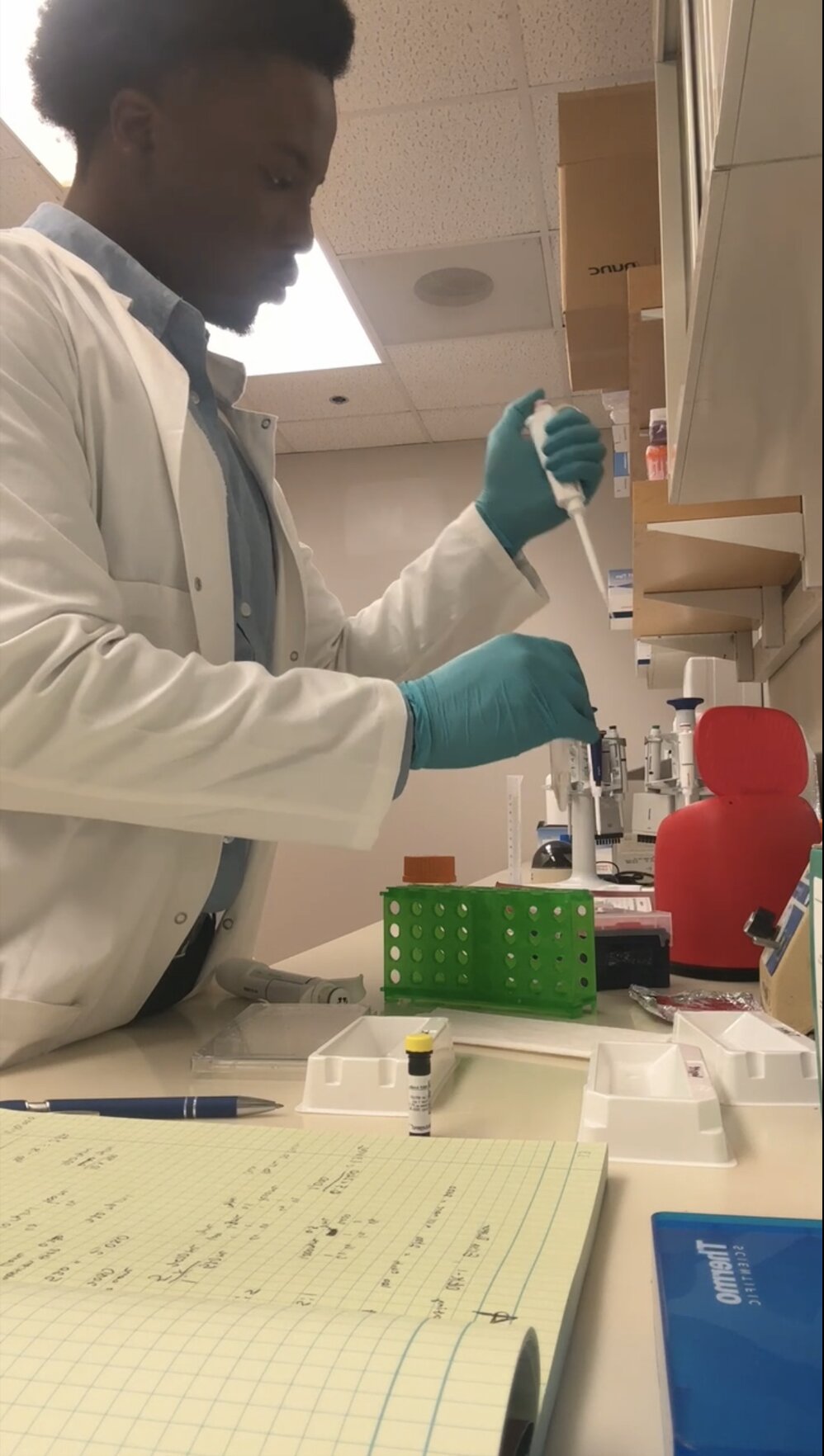
His responsibilities included preparing and purifying antibodies, analyzing experimental data and evaluating how well the resulting compounds bound to their intended targets. He also gained experience using sophisticated laboratory equipment, including high-performance liquid chromatography and mass spectrometry instruments.
The work introduced him to radiopharmacology, a field involving radioactive compounds used in diagnosing and treating disease, and gave him an opportunity to see how concepts he had encountered in the classroom could be applied to biomedical research.
One experience in particular stood out. “Seeing how scientific concepts I had learned about in coursework were translated into real-world applications for medical research was both fascinating and inspiring,” Shomide said after observing the radiolabeling process. “It reinforced my appreciation for the role research plays in improving patient care and outcomes.”
Shomide’s path to the Nemours lab began during his freshman year at Delaware State.
In 2025, he attended end-of-year research presentations through the Delaware IDeA Network of Biomedical Research Excellence, or Delaware INBRE. The statewide biomedical research network includes Delaware State University, the University of Delaware, Delaware Technical Community College, ChristianaCare and Nemours Children’s Health. The program helps expand biomedical research in Delaware while providing students with opportunities to gain hands-on research experience.
At the presentations, Shomide heard DSU Professor Hakeem Lawal discuss his work in teaching laboratories. Interested in gaining laboratory experience himself, Shomide approached Lawal after the event to ask about research opportunities. Lawal introduced him to Delaware INBRE.
That conversation led to Shomide’s first research internship under DSU faculty member Karl Miletti, Ph.D. During the spring semester of his sophomore year, Shomide worked on breast cancer research, gaining experience that would later help prepare him for the more specialized research environment at Nemours.
Shomide credits his DSU laboratory courses with giving him a foundation in skills such as pipetting, following research protocols, critical thinking and scientific problem-solving. His earlier research experience also taught him how to present scientific findings, communicate research and apply concepts from biology and chemistry to real scientific questions.
At Nemours, those skills continued to grow. Shomide said Yue and Karimi challenged him to expand his scientific knowledge while creating an environment where he felt comfortable asking questions and learning unfamiliar techniques.
“They were patient mentors who took the time to explain unfamiliar concepts and techniques, helping me build confidence in my abilities as a researcher,” he said. “Their support pushed me to learn something new every day, and the lessons I gained from working with them will continue to influence my academic and professional development.”
The internship helped Shomide strengthen his public speaking, data analysis and time-management skills. But one of the most important lessons, he said, was learning to step outside his comfort zone.
“At the beginning of the internship, I was nervous about entering a highly specialized research environment,” he said. “However, with the support and encouragement of my mentors, I gained confidence in my ability to learn, adapt, and contribute meaningfully to scientific research.”
His summer experience extended beyond the laboratory. Shomide also had the opportunity to shadow health care professionals in the Pediatric Intensive Care Unit, where he observed patient rounds and spoke with physicians and nurses.
For a student already considering a career caring for children, seeing both research and patient care within the same organization helped bring his future into sharper focus.
After graduating from Delaware State University, Shomide plans to attend medical school and pursue pediatrics or another child-focused medical specialty.
“That experience reinforced my desire to work with children and confirmed that I want to combine my interests in medicine and research to improve patient outcomes in the future,” Shomide said.
For Shomide, the summer brought together several parts of his journey, from the laboratory skills he developed at Delaware State and the opportunities he found through Delaware INBRE to his personal connection with Nemours and his goal of one day caring for children himself.