


DSU holds 4th Annual White Coat Ceremony
Delaware State University students received more than white coats at the University’s 4th Annual White Coat Ceremony. They also received advice from health care professionals who have already traveled many of the paths they hope to follow.
Held Tuesday, September 29, the ceremony brought together students from the College of Agriculture, Science and Technology and the Wesley College of Health and Behavioral Sciences to mark the beginning of their academic and professional journeys in health care.
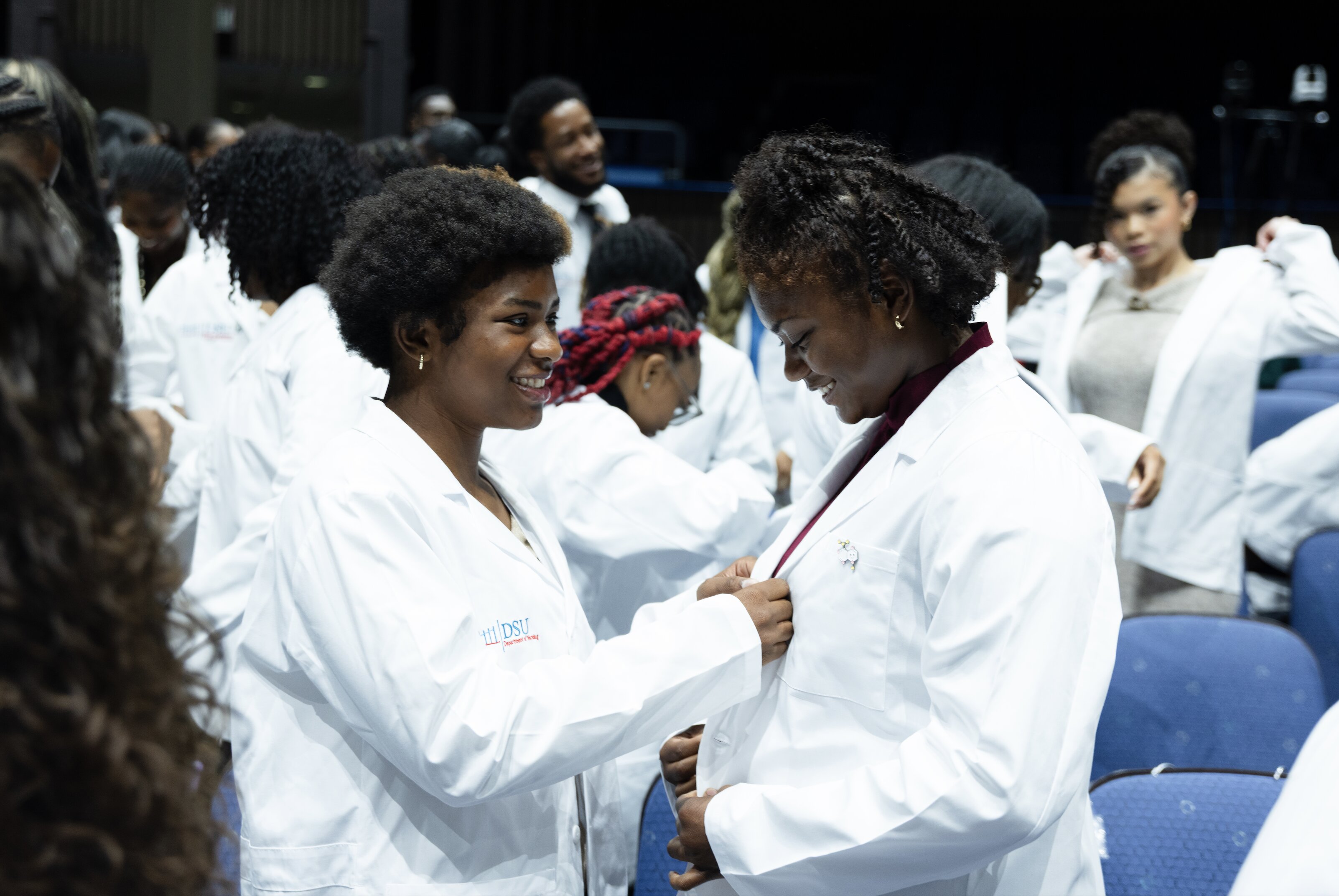
Before a panel of health care professionals took the stage, Dr. R. Christopher Mason, chair of the Department of Public and Allied Health Services spoke to students about the meaning and responsibility behind the white coat. Mason described the white coat as a symbol of trust and reminded students that caring for patients requires both knowledge and heart.
His remarks led into a panel discussion where several health care professionals shared lessons from their own experiences and offered guidance to students preparing for careers in the field.
Dr. Marshala Lee-McCall, a family medicine physician and director of the iREACH Harrington Community Partnership Fund, encouraged students to use their time at Delaware State University to explore the different opportunities available to them while building a strong academic foundation.
Lee-McCall stressed that academics are important, particularly for students hoping to enter competitive professional programs, but said their development should extend beyond the classroom.
“While you are a student, use this time to grow and explore all of the different options that are out there,” Lee-McCall said.
She encouraged students to reach out to professionals, try new experiences and build relationships that could help them throughout their careers. Lee-McCall shared that she did not know about public health when she first decided to become a doctor, but exposure to new opportunities eventually led her to earn a master’s degree in the field.
“You don’t know what you want to be until you try it,” she said.
Korinne Roach, a perioperative nurse at Bayhealth and DSU alumna, spoke about the importance of accepting challenges and opportunities even when students may not immediately understand how they fit into their plans.
Roach reflected on the choices students face in college, including whether to take on a leadership role, complete an optional assignment or gain experience in an area outside their major. She said those decisions can become an important part of a student’s development.
“I think those early decisions of doing the hard things, even when you don’t want to or don’t feel like it, or it doesn’t seem like it’s part of your journey, it is,” Roach said.
Dr. Brienne Flagg, an orthodontist, addressed students who may be interested in health care but have not yet decided exactly where they want their careers to take them. She reassured them that they do not need to have everything figured out now, but they should begin preparing themselves for the opportunities they may want to pursue.
Flagg emphasized maintaining strong grades, preparing for entrance exams and understanding the dedication required to attend medical, dental, veterinary or other professional schools.
“It might not be what you planned in the very beginning, but you look at the big picture, not just today,” Flagg said.

Dr. Shari Wallace, founder of SOMA Skin & Sculpt, spoke about persevering when others question whether you belong. Wallace shared her experience as the only Black resident in her residency program and recalled encountering people who made her feel as though she did not deserve to be there.
She also remembered the people who encouraged her during difficult moments, including nurses who offered support when she needed it.
“There will be times people will tell you you’re not good enough, and you have to know that that’s not true,” Wallace said.
Wallace encouraged students to rely on their families, faith and the people who support them while remaining confident in what they know about themselves.
Kimerly Holmes, an advanced practice nurse at Bayhealth and DSU alumna, encouraged students to advocate for themselves as they move from college into the workforce.
“Never let anyone put you in a box,” Holmes said.
Holmes explained that professional development opportunities will not always be offered automatically. She encouraged students to approach supervisors and managers, express what they want to accomplish and ask for opportunities that can help them grow.
“Never be afraid to speak up and take your space in that room,” Holmes said.
Dr. Ariana Ross Schneiderhan, a second-year family medicine resident at Bayhealth, shared how an early setback in her own career taught her to adjust without abandoning her goal.
Schneiderhan was not accepted into medical school the first time she applied. She realized she needed more experience and decided to continue working toward becoming a physician rather than allowing the rejection to end that pursuit.
“I could have taken that moment to give up,” Schneiderhan said. “I didn’t.”
She gained additional experience, applied again and was accepted the second time. Schneiderhan encouraged students to recognize what they can control and learn to adapt when circumstances force their plans to change.
Dr. Lydell C. Lettsome, a surgeon at Bayhealth, stressed the importance of actively pursuing opportunities and building relationships with people who can help students along the way.
Lettsome encouraged students to attend professors’ office hours, take advantage of tutoring, prepare for entrance exams, find mentors and seek research experiences. He reminded them that achieving their goals requires effort outside the classroom and encouraged them to continue knocking on doors when opportunities do not immediately appear.
“You’re not going to get the opportunity if people don’t know you exist,” Lettsome said.
He also encouraged students to support one another and maintain relationships with their peers, noting that having people who are willing to advocate for them can make a difference as they progress through their careers.
The panelists represented different areas of health care and took different paths to reach their professions, but their experiences gave students a broader picture of what the journey can require. Their advice emphasized academic preparation, mentorship, perseverance, self-advocacy, professional relationships and a willingness to adjust when plans do not unfold as expected.
For the students receiving their white coats, the ceremony recognized an important point in their education while giving them an opportunity to learn from professionals who understand both the challenges and possibilities that await them in health care.